
In the rush to build and launch many founders skip the most foundational step: building an ICP (your Ideal Customer Profile). It seems obvious, almost too simple. But ignoring it means misalignment that can become almost impossible to unwind from.
Working with early-stage and growth-stage companies navigating product-market fit and planning their GTM strategies has shown me a clear pattern. Teams that anchor to their ICP make better decisions which helps them grow faster. Those that don’t seem to spin in circles, waste money and misdirect teams by continually “flip-flopping.”

I get it. Fear plays a big part in determining exactly who you’re going after. It feels limiting. But, here’s why understanding your ICP isn’t optional, and how it informs everything else.
1. Product should solve a problem for someone specific, with specific “jobs to be done”
Too many products are built for “everyone,” which usually means they resonate with no one. When your ICP isn’t clearly defined, the temptation is to chase feature requests from anyone willing to talk. That leads to bloat and a scattered roadmap. It also leads to a bunch of features that 80% of your clients aren’t even using. (Hello Zoom…why are you building a document repository to go up against GSuite & Sharepoint).
When you know exactly who your’re building, and more importantly, who it is NOT for, your team can prioritize with clarity. Features that serve your ICP get shipped first. Problems they actually experience get solved. Everything else can wait. Scary, I know, but effective (and watch your NRR climb).
Understanding your ICP forces you to ask: who is the best-fit customer? What is the painful, valuable, frequent problem they need solved? And how does our product uniquely solve it for them?
2. Messaging becomes 10x easier (and more effective)
Vague messaging is one of the most common symptoms of an unclear ICP. If your homepage could describe half a dozen other tools, your message isn’t landing.
Clear ICP means clear messaging. When you know your customer’s job, pain, goals, and context, you can speak their language. You can reflect their reality back to them. And you can position your product as a solution they understand.
This doesn’t just help top-of-funnel conversion. It helps across the board. Sales conversations become tighter, onboarding becomes smoother, investor decks sharper, and internal alignment improves because everyone is talking the same language. Imagine a BBQ where every employer answers the same way when the question asked is…“So, what does your company do?”.

3. Prioritization across the business becomes simpler
Every team makes trade-offs. What to build. Who to sell to. Which customers to support. Without a clear ICP, these decisions get made reactively or emotionally. And I’d suggest emotionally is the 80% winner in the 80/20 rule here.
With a defined ICP, you can use a single, shared filter: does this serve our ideal customer? Yes/No should be the only answer. Forget those fringe cases…there’ll always be fringe cases clouding your focus.
This lens sharpens product planning, informs pricing and packaging, and helps marketing know what content to create and where to distribute it. It even shapes hiring. Do you need someone who knows enterprise deals or PLG motion? That depends on who your ICP is.
4. GTM motions can‘t work without ICP clarity
The success of your GTM strategy, whether inbound, outbound, community-led, partner-led, event-led… depends on knowing who you are targeting.
Without an ICP, sales teams waste cycles on poor-fit leads. Marketing spends on channels that do not connect (and definitely not convert). Founders spin their wheels trying to “fix” teams, when this is fundamentally NOT the problem. You could hire the most talented sales team on the planet, but if they’re focused on the wrong value messaging, none of them are making Trip next quarter.
GTM is not about tactics. It is about alignment. And alignment starts with ICP.
Ask yourself: where do our ideal customers spend time? Who do they listen to? What triggers their buying process? The answers shape the channel strategy, content plan, and the sales enablement decks.
5. Your ICP is not a persona. It is a strategic decision.
One of the biggest mistakes teams make is confusing personas with ICP. Personas can be useful, but they are often superficial. “Sarah is a 35-year-old PM who likes coffee and uses Slack.”
ICP is sharper. It is about company size, industry, maturity, pain points, urgency, budget, decision-making dynamics, and usage patterns. It’s a decision: this is who we’re for right now.
Defining the ICP doesn’t mean ignoring everyone else. But it does means you can finally align your product, messaging, and GTM to serve one segment…exceptionally well. Because that’s how you win in competitive markets.
Start here, before anything else
I know how tempting it is to jump straight into building, launching, and selling. But skipping the ICP work is like building on sand. You’ll move fast, but perhaps not in the direction you want.
Start by interviewing your best customers. Look at usage data. Study closed-won and closed-lost deals. Identify the patterns. Codify the profile. Pressure test it.
When your ICP is clear, everything else becomes easier. Every decision gets faster. And your GTM becomes a focused, repeatable motion instead of a guessing game.
TL;DR: What Doesn’t Work When ICP Is Wrong?
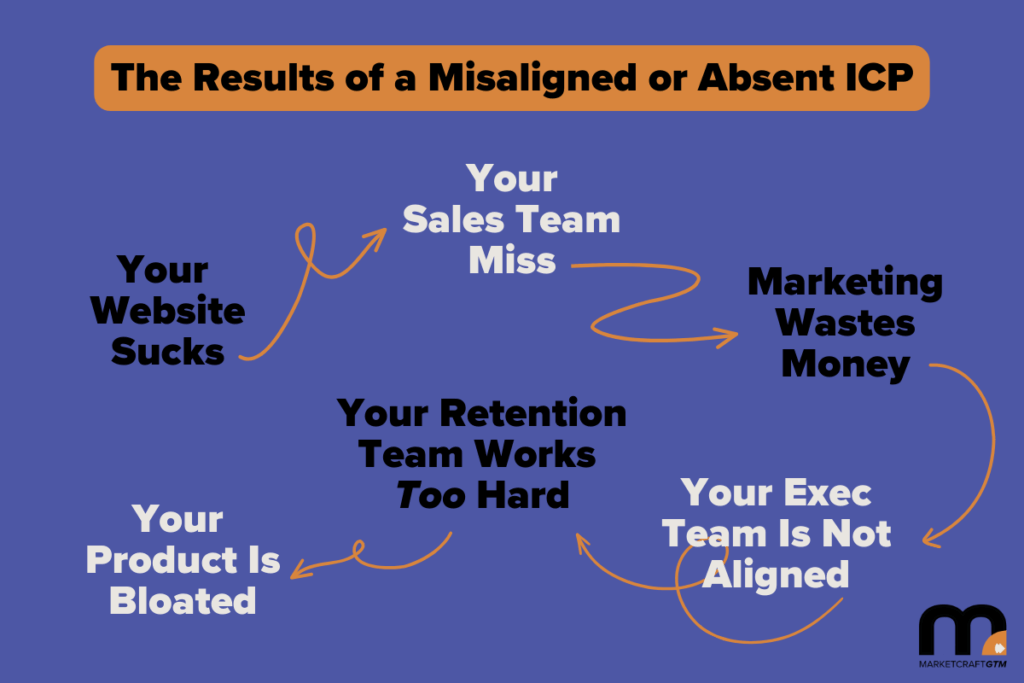
Don’t worry…all hope isn’t lost!
Book a time if you’re struggling to define your ICP, or want a second set of eyes. It’s the first question we work through with every client, and the foundation we help them build everything else on.

